
Survive Your Ideas Tips & Winning Strategy
8 documented hazards · word-reading discipline · endgame resource play · economy tips that fund the meta
The Hierarchy Of Skills
Survive Your Ideas looks like a chaos game, but consistent winners share a learnable skill stack. In order of impact: word reading (moving on the typed word, not the spawn), route discipline (two escape routes, always, re-planned every few minutes), crowd sense (never standing where the panic will run), turn strategy (diary words early, pressure words late), and economy management (Cash to Meta Words, code spins to items). This page walks each layer, building on the beginner guide.
Skill One: Read The Word, Not The Spawn
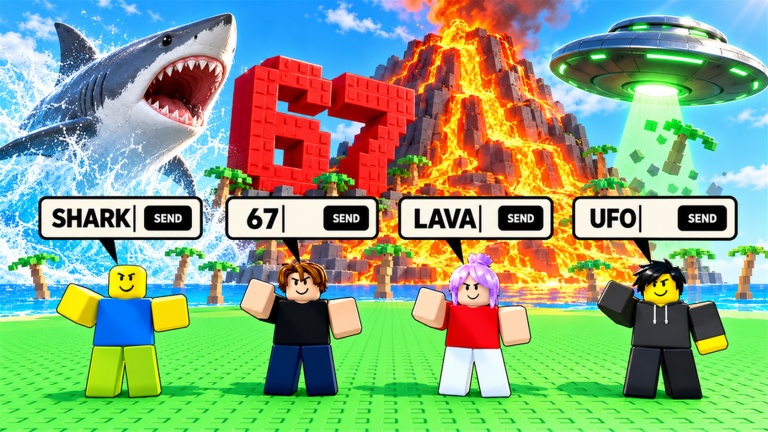
The game's core information loop is public and instant: every typed word appears on screen the moment it is entered, while the effect takes a visible delay to materialize. That gap is your reaction window, and treating it as sacred is the whole skill. Practical drills: when any word lands, name its family in your head before you move (blast? flood? chaser? persistent?) — the words list gives you the catalog, and after a few matches family recognition is instant. Second drill: move on the word, then adjust on the spawn. The first move wins the race; the second fixes the read.
The failure mode is watching the effect. New players stare at the tsunami forming, the dinosaur emerging — and burn their reaction window on spectacle. The word told you everything a second earlier; the spawn is just confirmation. Players who internalize this one habit routinely double their survival time without touching any other part of their game.
Skill Two: Route Discipline In A Stacking Arena
Words stack — the documented core escalation — so the arena you planned around sixty seconds ago no longer exists. The discipline that survives this: two escape routes, always, one primary and one backup, mentally refreshed every time a new word lands. The backup route is what separates survivors from statistics, because stacked-hazard deaths follow one pattern with mechanical reliability: dodging the newest hazard directly into the oldest one.
Retreat order matters: when the arena compresses, solve for the oldest active hazard first, because its footprint is the one your retreat path crosses. New effects demand reads but old hazards kill during the retreat. And re-verify height: floods reward verticality, but persistent aerial words (METEOR) turn the highest perch into a fixed target — the "safe spot" is a rotating designation, not a permanent address.
Skill Three: Crowd Sense
Forty players share impulses: loot attracts, bottlenecks compress, and "safe" spots draw crowds. Every crowd is a future disaster zone — area words typed into a clustered lobby do their worst work, and panic movement after each new word kills more players than the hazards themselves. The habits: spawn-side positioning away from obvious attractors, crossing bottlenecks immediately or late (never in the middle wave), and letting the crowd fight the chaser while you take the long quiet route. Crowd avoidance is also the offensive playbook's mirror: the best-words timing section is essentially this skill in reverse — hunting crowds instead of leaving them.
Skill Four: Your Writer Turn Is A Budget
You get limited turns, and each one is spent from three accounts: pressure (eliminations), collection (diary bonuses), and comedy (clips). The allocation that wins: safe catalogued words early — the calm opening minutes are when banking undiscovered entries costs nothing — pressure words held for the late game when the survivor count makes each one decisive, and at most one gag input per session. The economy behind this is covered on the words page (diary mechanics) and quantified on the Cash Planner. Meta Words extend the budget further: /double doubles a turn's value, /secret denies the lobby's read entirely — the full arsenal with prices is on the Meta Words page.
Skill Five: Endgame Discipline
The final circles are won by resources, not reflexes. The players still standing at word sixty are the ones who did not panic-spend Force Field at word twenty or burn mobility cooldowns on cosmetic dodges. The checklist for endgame: unspent defense item, mobility ready, position near cover but out of dead ends, and your biggest held word ready for the final compression. Champion and Unstoppable are decided here — the badges page maps which achievements each skill feeds.
The Economy Layer Under Everything
Long-run improvement is funded: Cash buys Meta Words, diary bonuses compound, and code-funded Lucky Spins cover the item grind without touching your savings. The two rules that protect the engine: never buy regular spins while a Meta Word is within reach (ten spins equal one /double), and redeem codes after every update — free rolls are rolls that keep the fund intact. For the item-side logic (which slots to fill, in what order), the items page has the loadout breakdown, and the Spin Planner prices your roll decisions in Meta Word time.
Tips FAQ
What is the single biggest skill in Survive Your Ideas?
How do I survive long matches (60+ words)?
Should I type dangerous words or safe words on my turn?
What's the best endgame strategy?
How do I avoid dying to stacked hazards?
Do items matter more than positioning?
How should I use my Cash — spins or Meta Words?
Data checked November 8, 2026. Survive Your Ideas updates often — we re-verify codes and numbers after each update.